print('.'*5).....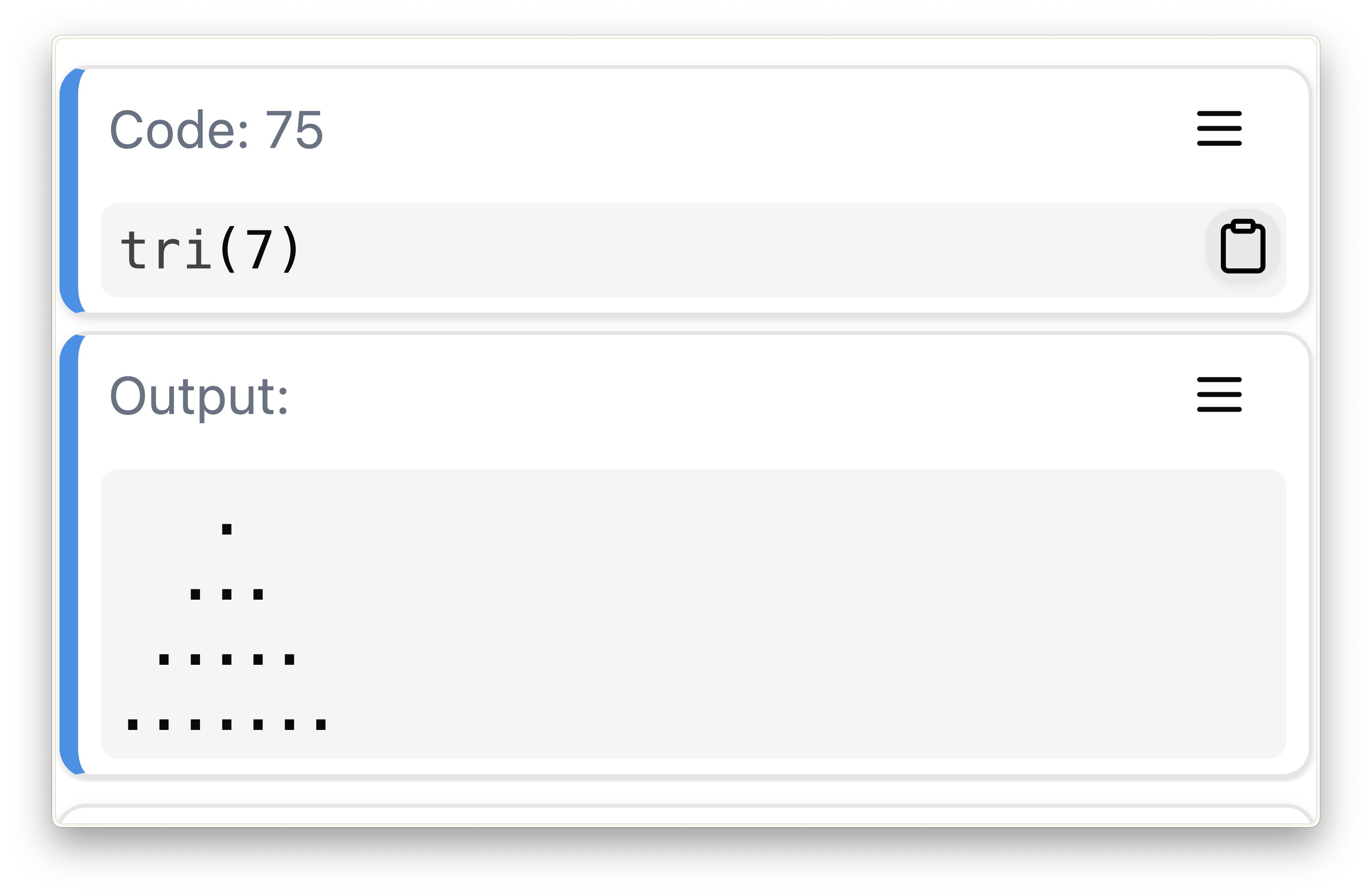
Here, I demonstrate my process in working out a centered triangle. If you have a cooler way to print one, let me know!
I’ll begin by printing a regular 5x5 grid. A 5x5 grid has 5 rows. So I’ll work with rows. A row has 5 elements.
print('.'*5).....We repeat this 5 times to get a 5x5 grid.
dim = 5
for n in range(dim):
    seg = '.'*dim
    print(seg)
.....
.....
.....
.....
.....We could make this into a one liner.
print('\n'.join('.'*dim for n in range(dim))).....
.....
.....
.....
.....The next most simplest action I can take is to print a right triangle. This is matter of successively printing \(x+1\) items.
l = 5
for n in range(l): print('X'*n)
X
XX
XXX
XXXX
We need to adjust l by 1.
for n in range(1,l+1): print('X'*n)X
XX
XXX
XXXX
XXXXXWhat if I want to print . as padding for those spaces where the triangle doesn’t exist? If a row contains 5 elements,
X and 4 .X and 3 .X and 2 .for n in range(1,l+1): print(f'{l-n=}')l-n=4
l-n=3
l-n=2
l-n=1
l-n=0for n in range(1,l+1):
padding = l-n
print('X'*n + '.'*padding)X....
XX...
XXX..
XXXX.
XXXXXIn 1 line.
print('\n'.join('X'*n + '.'*(l-n) for n in range(1,l+1)))X....
XX...
XXX..
XXXX.
XXXXXNow if the output above is closely observed, the difference in having a neatly centered triangle is odd rows can only be output. The modulo operator % can help me determine what numbers are odd.
1%2, 2%2, 3%2, 4%2(1, 0, 1, 0)for n in range(1,l+1):
if n%2==1: print('X'*n + '.'*(l-n))X....
XXX..
XXXXXTo center this triangle, I just have to split the padding on either side.
for n in range(1,l+1):
    padding = (l-n)//2
    if n%2==1: print('.'*padding + 'X'*n + '.'*padding)
..X..
.XXX.
XXXXXI don’t actually need to use % to determine what number is odd. The third parameter of range lets us define the step.
list(range(1,5,2))[1, 3]for n in range(1,l+1,2):
pad = (l-n)//2
print(' '*pad + '.'*n + ' '*pad) .
...
.....Python has built-in ways to justify text. > right aligns, < left aligns, and ^ centers.
print(f'{'haha':>8}\n{'haha':<8}\n{'haha':^8}') haha
haha
haha If I don’t want to use whitespace to justify, Python has the rjust, ljust, and center methods.
print(f'{'haha'.rjust(8,'-')}\n{'haha'.ljust(8,'-')}\n{'haha'.center(8,'-')}')----haha
haha----
--haha--Back to the triangle.
for n in range(1,l+1,2): print(f'{'.'*n:^{l}}') .
...
.....In 1 line.
print('\n'.join(f'{'.'*n:^{l}}' for n in range(1,l+1,2))) .
...
.....Justifying with another character.
print('\n'.join(f'{('.'*n).center(l, '#')}' for n in range(1,l+1,2)))##.##
#...#
.....If you have any comments, questions, suggestions, feedback, criticisms, or corrections, please do post them down in the comment section below!
Back to top